PPO vs. HMO: Which Health Insurance Plan Is Right for You?
If you've ever tried to compare health insurance plans, you've probably discovered something very quickly:
Insurance companies really like their acronyms.
PPO. HMO. EPO. HSA.
And just when you think you've figured one out, another three-letter combination appears.
But here's the good news:
You don't need to memorize a dictionary of insurance abbreviations to choose a health plan.
Today, we're focusing on two of the most common types you'll encounter:
PPO vs. HMO.
So what's the difference?
And more importantly, which one might be right for you and your family? Let's break it down without the confusing jargon.
What Is the Difference Between a PPO and an HMO?
The biggest difference between a PPO and an HMO comes down to how you access healthcare and how the plan's network works.
In simple terms: HMO
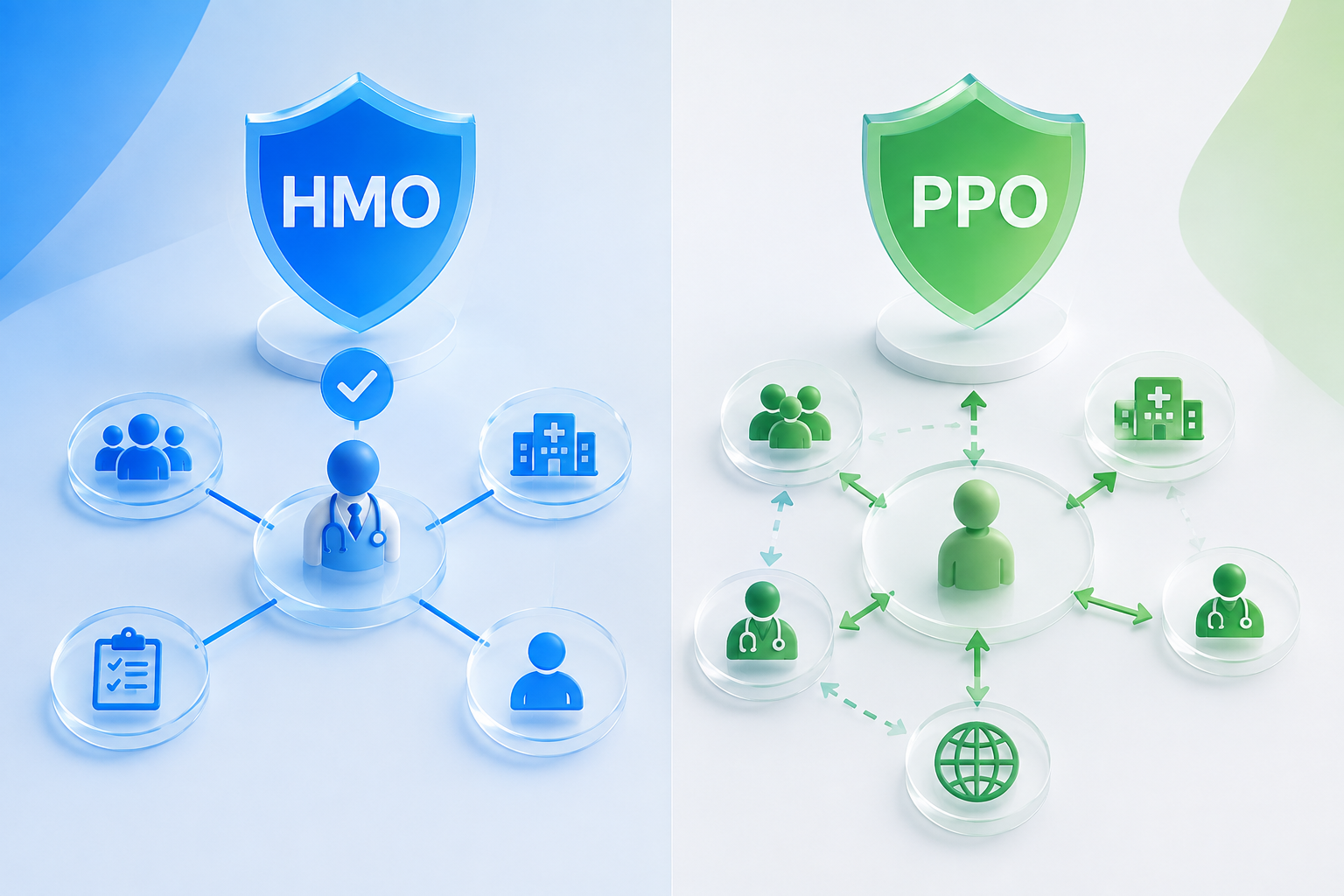
An HMO, or Health Maintenance Organization, generally encourages you to receive care from doctors and providers within the plan's network. You will typically choose a primary care provider, or PCP, who helps coordinate your care. Depending on the plan, you may need a referral from your PCP before seeing certain specialists.
PPO
A PPO, or Preferred Provider Organization, generally gives you more flexibility when choosing healthcare providers. You can typically see specialists without getting a referral from your primary care doctor, depending on your specific plan. You can also generally receive care outside the plan's network, although you'll usually pay more for doing so.
That's the basic difference. But let's dig a little deeper.
PPO vs. HMO: A Simple Example
Imagine you wake up one morning and realize something is wrong. You need to see a doctor. With an HMO, your healthcare experience may look something like this:
You → Primary Care Doctor → Specialist if needed
Your PCP is often the starting point for your care. With a PPO, your experience may be more flexible:
You → Primary Care Doctor OR Specialist
You generally have more freedom to choose where you go for care, particularly within the plan's network. Neither approach is automatically better.
It depends on how you prefer to manage your healthcare.
What Is an HMO Health Insurance Plan?
Let's start with the HMO. An HMO is designed around a network of healthcare providers who have agreed to provide services under the plan's terms. Generally, you'll choose a primary care provider who becomes your main point of contact for your healthcare.
Your PCP can help coordinate things like:
Routine appointments
Preventive care
Referrals
Specialist visits
Ongoing healthcare needs
One of the biggest advantages of an HMO is that it can make healthcare feel more structured. You have a starting point. You know who to call. And your primary doctor can help coordinate your care. For someone who likes simplicity and doesn't mind staying within a network, that can be appealing.
What Are the Potential Advantages of an HMO?
Depending on the specific plan, an HMO may offer:
Lower monthly premiums
Lower out-of-pocket costs for certain services
A coordinated approach to healthcare
A defined network of providers
A primary care doctor who helps manage your care
HMO plans can be particularly appealing to people who don't mind using a specific network and prefer having their care coordinated. But there are trade-offs.
What Are the Potential Downsides of an HMO?
The biggest consideration is network flexibility. If you want to see a doctor who isn't part of your HMO's network, you may have limited coverage for that care, except in certain situations such as emergencies.
You may also need a referral to see certain specialists, depending on the plan. That can feel restrictive if you're someone who likes to choose your own specialists.
For example, imagine you have a heart condition and want to see a particular cardiologist. With an HMO, you may need to start with your PCP and get a referral before seeing the specialist.
For some people, that's perfectly fine. For others, it's a hassle.
What Is a PPO Health Insurance Plan?
Now let's look at the PPO. A Preferred Provider Organization generally gives you more freedom when choosing healthcare providers.
You can typically:
Choose doctors within the network
See specialists without a referral
Receive some coverage for out-of-network care
Choose from a broader range of providers
The key word here is flexibility.
A PPO may be attractive to someone who doesn't want to feel like they need permission to see a specialist. It's also potentially useful for people who travel frequently or want more options when choosing healthcare providers.
But again, flexibility can come at a price.
What Are the Potential Advantages of a PPO?
Depending on the plan, PPOs may offer:
Greater provider flexibility
No referral requirement for many specialist visits
Some out-of-network coverage
More freedom when choosing healthcare providers
Greater flexibility for people who travel
For someone who values choice and convenience, a PPO can be attractive. Let's say you already have a specialist you trust. You don't want to change doctors. And you don't want to call your primary doctor every time you need to see that specialist. A PPO may give you more flexibility.
What Are the Potential Downsides of a PPO?
The biggest trade-off is often cost. PPO plans may have higher monthly premiums than comparable HMO plans, although this varies significantly by plan. You may also pay more when you use out-of-network providers.
And that's an important point:
Out-of-network doesn't mean free.
A PPO may provide some coverage outside the network, but your share of the cost can be substantially higher. So if you're considering a PPO because of its flexibility, make sure you understand what that flexibility could cost.
PPO vs. HMO: Which Is Cheaper?
This is one of the most common questions. ,And unfortunately, there's no universal answer. The cost of a health insurance plan can depend on factors such as:
Where you live
Your age
The insurance company
Your coverage level
Whether you're covering yourself or your family
The plan's deductible
Copayments
Coinsurance
Provider network
Out-of-pocket maximum
In general, HMO plans may have lower premiums and out-of-pocket costs than PPO plans, but you shouldn't assume that's always the case. Instead, compare the actual numbers. And don't look at the monthly premium alone.
Don't Make the "Cheapest Plan" Mistake
Here's one of the biggest mistakes people make when shopping for health insurance: They find the lowest monthly premium and immediately think:
"That's the best deal."
Not necessarily. Imagine two plans:
Plan A
$300/month
But it has:
Higher deductible
Higher cost-sharing
Smaller network
Plan B
$425/month
But it has:
Lower deductible
More provider flexibility
Better coverage for the doctors you already use
If you visit the doctor frequently, Plan B might actually make more sense financially. That's why you should consider total potential healthcare costs, not just your monthly premium.
PPO vs. HMO: What About Your Doctors?
This might be the most important question of all.
Where does your doctor fit?
Before choosing a plan, make a list of:
Your primary care doctor
Specialists
Preferred hospital
Pediatrician
Therapists
Other healthcare providers
Then check whether they're in the plan's network. Don't assume. Insurance networks can change. And just because a doctor accepts "the insurance company" doesn't necessarily mean they participate in every plan that company offers. The specific plan matters.
PPO vs. HMO: What About Referrals?
Here's another important difference. With many HMO plans, you generally need to work through your primary care provider when you want to see certain specialists. With many PPO plans, you generally don't need a referral to see a specialist. However, plan rules vary.
So don't rely on the letters "HMO" or "PPO" alone. Always check the actual plan documents. Think of the plan type as your road map. The individual plan tells you the actual rules of the road.
Which Is Better for Families?
This depends entirely on your family's healthcare needs.
An HMO may make sense for a family that:
Wants predictable, coordinated care
Is comfortable using a specific network
Doesn't mind referrals
Wants to potentially save on premiums
Already has doctors within the network
A PPO may make sense for a family that:
Wants more provider flexibility
Regularly sees specialists
Travels frequently
Wants out-of-network options
Doesn't want to deal with referrals
But don't choose based on a checklist alone. Your family's situation is unique.
Which Is Better If You Travel?
This is an important consideration. If you travel frequently, especially across different states, pay close attention to how your health plan handles care outside your local network.
A PPO may offer more flexibility for out-of-network care than an HMO, but the exact rules vary by plan.
And remember: Emergency care is different from routine care.
Don't assume your regular out-of-network doctor visit will be treated the same way as an emergency. If you travel often, ask the insurance company exactly how your plan handles:
Emergency care
Urgent care
Routine doctor visits
Specialist visits
Out-of-network care
What About Prescriptions?
Don't forget about prescription coverage. When comparing PPO vs. HMO plans, look at the plan's drug coverage as well.
Make a list of your current medications and check:
Are they covered?
What tier are they on?
What's the copay?
Is your preferred pharmacy in network?
Is mail-order available?
A health insurance plan can look great until you discover your family's prescriptions cost significantly more than expected.
A Simple PPO vs. HMO Comparison
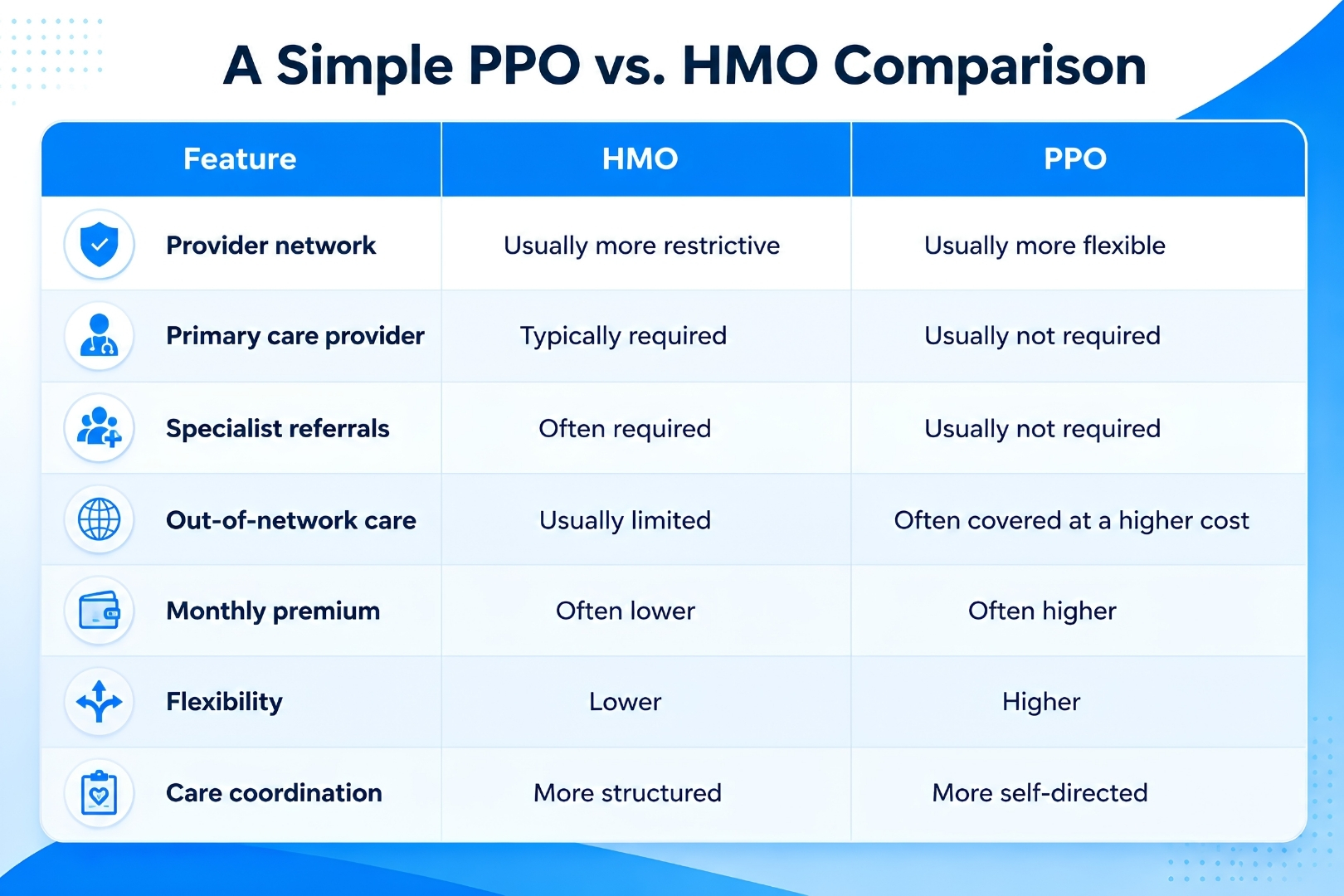
Important: These are general characteristics. Specific plan rules, costs, networks, referrals, and benefits can vary, so always review the actual plan you're considering.
So... Which One Should You Choose?
Here's the answer nobody loves:
It depends. But that's actually a good thing. It means you don't have to choose what works for someone else. You can choose based on what works for you.
Ask yourself:
Do I want more freedom? If yes, you may lean toward a PPO.
Do I prefer coordinated care? An HMO may be worth considering.
Do I see specialists regularly? Pay close attention to referral requirements and specialist networks.
Do I travel frequently? Look carefully at out-of-network and out-of-area coverage.
Is keeping my current doctor important? Check the provider network before enrolling.
Is keeping my monthly premium low a major priority? Compare HMO and PPO premiums—but also compare deductibles and out-of-pocket costs.
7 Questions to Ask Before Choosing a Health Plan
Before you sign up, grab a piece of paper and answer these:
Is my doctor in the network?
Are my prescriptions covered?
Do I need referrals to see specialists?
What happens if I go out of network?
What's my deductible?
What's my maximum out-of-pocket cost?
How much could I realistically spend on healthcare in a year?
Those seven questions can tell you a lot more than simply asking:
"Which plan is cheapest?"
How Dale and Rachel Earp Approach Health Insurance
At We Know Life & Health, Dale Earp and Rachel Earp believe health insurance shouldn't feel like something families have to figure out alone.
Dale Earp knows that people want straightforward answers. They don't want someone throwing insurance terminology at them and hoping they figure it out.
And Rachel Earp believes asking questions is part of making a smart insurance decision—not a sign that you don't understand insurance.
Because honestly, insurance can be confusing. There's no prize for pretending it isn't. The goal is to understand what you're buying, what it costs, and how it works when you actually need it. That's what matters.
Frequently Asked Questions About PPO vs. HMO
Is a PPO better than an HMO?
Not necessarily. A PPO generally offers more flexibility, while an HMO may provide more structured care and potentially lower costs. The better choice depends on your doctors, healthcare needs, budget, and preferences.
Is an HMO cheaper than a PPO?
HMO plans often have lower premiums than PPO plans, but this isn't guaranteed. Compare the premium, deductible, copays, coinsurance, and maximum out-of-pocket costs before making a decision.
Can I see a specialist without a referral with a PPO?
Generally, PPO plans allow you to see specialists without a referral, but plan rules vary. Always confirm the requirements for the specific plan you're considering.
Can I see an out-of-network doctor with an HMO?
Generally, HMO plans provide little or no coverage for routine out-of-network care, except for certain situations such as emergencies. Check the specific plan's rules before receiving care.
Can I see an out-of-network doctor with a PPO?
Many PPO plans provide some coverage for out-of-network care, but you'll typically pay more. The amount of coverage varies by plan.
Which is better for a family: PPO or HMO?
There's no universal answer. Families who value lower costs and coordinated care may prefer an HMO, while families who want greater provider flexibility may prefer a PPO.
Should I choose a plan based only on the premium?
No. Consider the complete cost of coverage, including premiums, deductibles, copayments, coinsurance, prescriptions, and potential out-of-pocket expenses.
Final Thoughts: Choose the Plan That Fits Your Life
When it comes to PPO vs. HMO, there isn't a magical answer that works for everyone. And that's actually the best part.
Your health insurance should reflect your life. If you value flexibility, a PPO may be worth exploring. If you prefer coordinated care and staying within a defined network, an HMO may be a better fit.
But don't stop there. Look at your doctors. Look at your prescriptions. Look at your budget. Look at how often your family uses healthcare. And think about what would happen if you suddenly needed more medical care than expected.
Because the right health insurance plan isn't necessarily the one with the lowest premium. It's the one that gives you the right combination of coverage, access, flexibility, and affordability for your family's situation.
And if you still aren't sure? That's okay. That's exactly what questions are for.
Need Help Comparing Your Health Insurance Options?
Choosing between a PPO and HMO can feel overwhelming when you're looking at premiums, deductibles, networks, referrals, and a dozen other details.
You don't have to figure it all out by yourself.
Reach out to We Know Life & Health today to learn more about your health insurance options and get help understanding what may fit your family's needs.
Because health insurance shouldn't make you feel more confused than when you started.
You may also enjoy these related articles: What Is Marketplace Health Insurance? What Every Family Should Know
Education first. Relationships always.